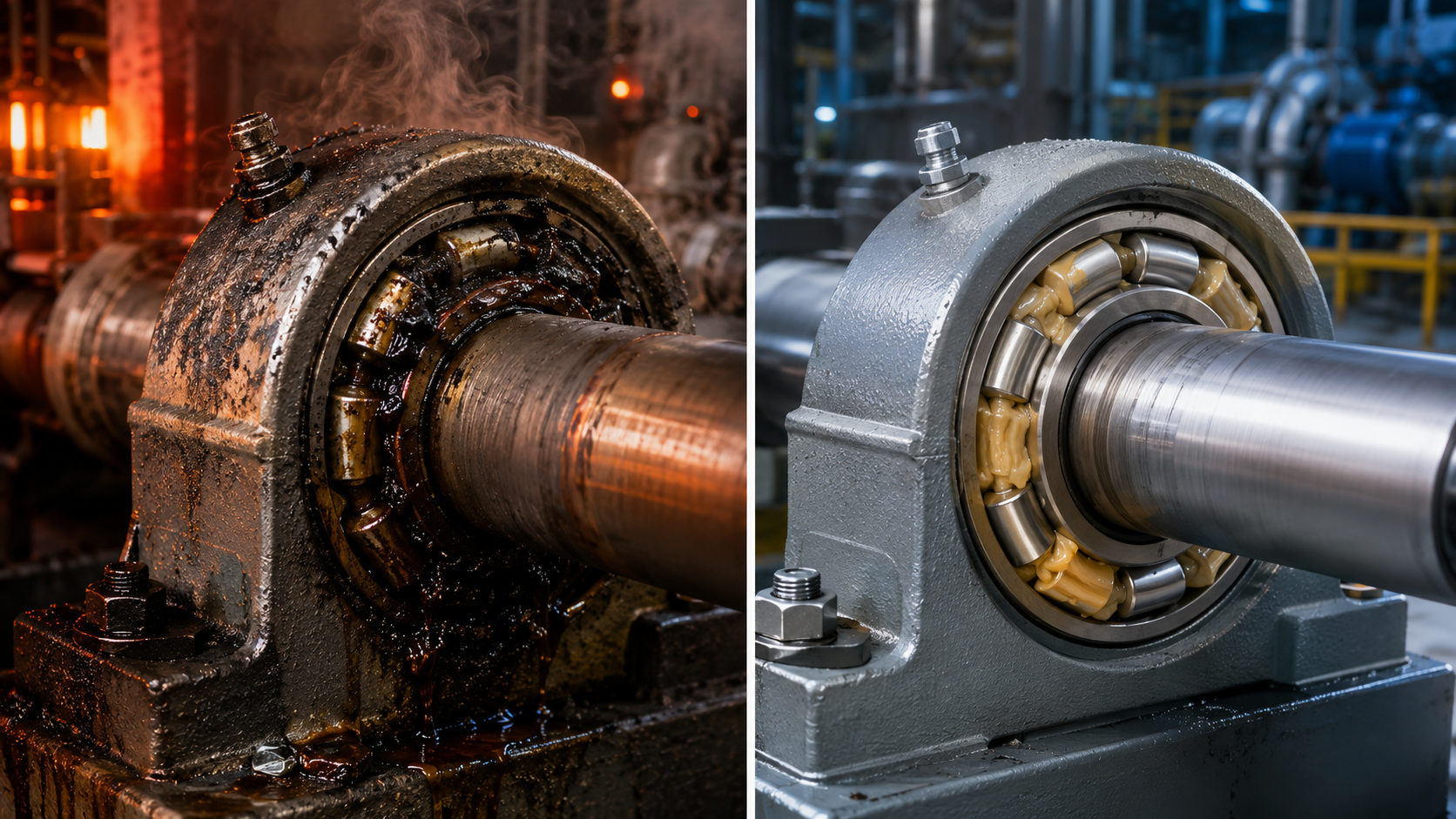
3 Signs Your Lubricant Is Failing Before Your Equipment Does





The most frustrating equipment failures are the ones that felt sudden, but weren't.
In most cases, lubricant degradation doesn't happen all at once. It happens gradually, through a series of changes that are detectable if you know what to look for. The facilities with the best reliability records aren't necessarily the ones with the newest equipment. They're the ones who've learned to read the early signals.
Here are three of the most common indicators that a lubricant is breaking down, and what each one means.
Fresh oil has a characteristic color based on its type and formulation. When that color changes, something has happened.
Darkening, moving from amber to dark brown or black, typically indicates oxidation or thermal degradation. The oil has been exposed to excessive heat or oxygen over time, and its protective chemistry is breaking down. Mild darkening over a full service interval can be normal. Rapid darkening between scheduled samples is not.
A milky or cloudy appearance almost always means water contamination. Even small amounts of water can cause this, and water contamination can cut bearing life by 50% or more by disrupting the lubricant film.
Bright colors mixed into oil typically signal coolant contamination, which is a serious condition requiring immediate attention. Glycol from a failed head gasket or cooler is extremely destructive to lubricant chemistry and metal surfaces.
Viscosity, the oil's resistance to flow, is the single most important lubricant property. When viscosity moves outside the target range, equipment protection is compromised.
Oil that's become thicker than specified may be oxidized, contaminated with soot, or have had its additives react in ways that increase consistency. Oil that's become thinner may have experienced shear degradation, fuel dilution, or the addition of a wrong-viscosity lubricant during a top-off.
In the field, a rough viscosity check can be done by feel, comparing fresh oil from the same product to a small sample on a clean surface. But oil analysis viscosity measurement is the reliable method, and a trend of viscosity drift over several samples is far more meaningful than any single data point.
Heat is both a symptom and an accelerant of lubricant failure. When a lubricant begins to break down, it provides less effective film separation between metal surfaces. Increased metal-to-metal contact generates more friction, which generates more heat, which accelerates further breakdown.
Infrared thermometers and ultrasonic instruments can identify bearing surfaces running above their baseline temperature before the failure cycle becomes self-sustaining. The key word is "baseline." Equipment that's always run a little hot isn't necessarily failing, but equipment that's running hotter than its own history is telling you something.
The most common reason these early warnings get ignored isn't inattention. It's normalization. Changes that happen gradually become the new normal. Oil that darkened over three months looks fine compared to last month, even though it's far from where it started.
This is why documented baselines and trending matter. Human perception adjusts. Data doesn't.
Don't just change the oil and move on. These signals are diagnostic. They point to a root cause, such as a failed seal, a compromised breather, or an operating condition pushing equipment beyond design parameters, that will cause the same problem again if left unaddressed.
Delta360's lubrication specialists are MLT and MLA certified and embedded onsite at facilities across the Gulf Coast. Our oil analysis program, run through MRT Laboratories with CLS review, is designed to catch these signals early and translate them into action, not just reports.

.png)








.png)
.png)