High Temp Grease for Industrial Equipment: Why the Right Formula Prevents Costly Failures





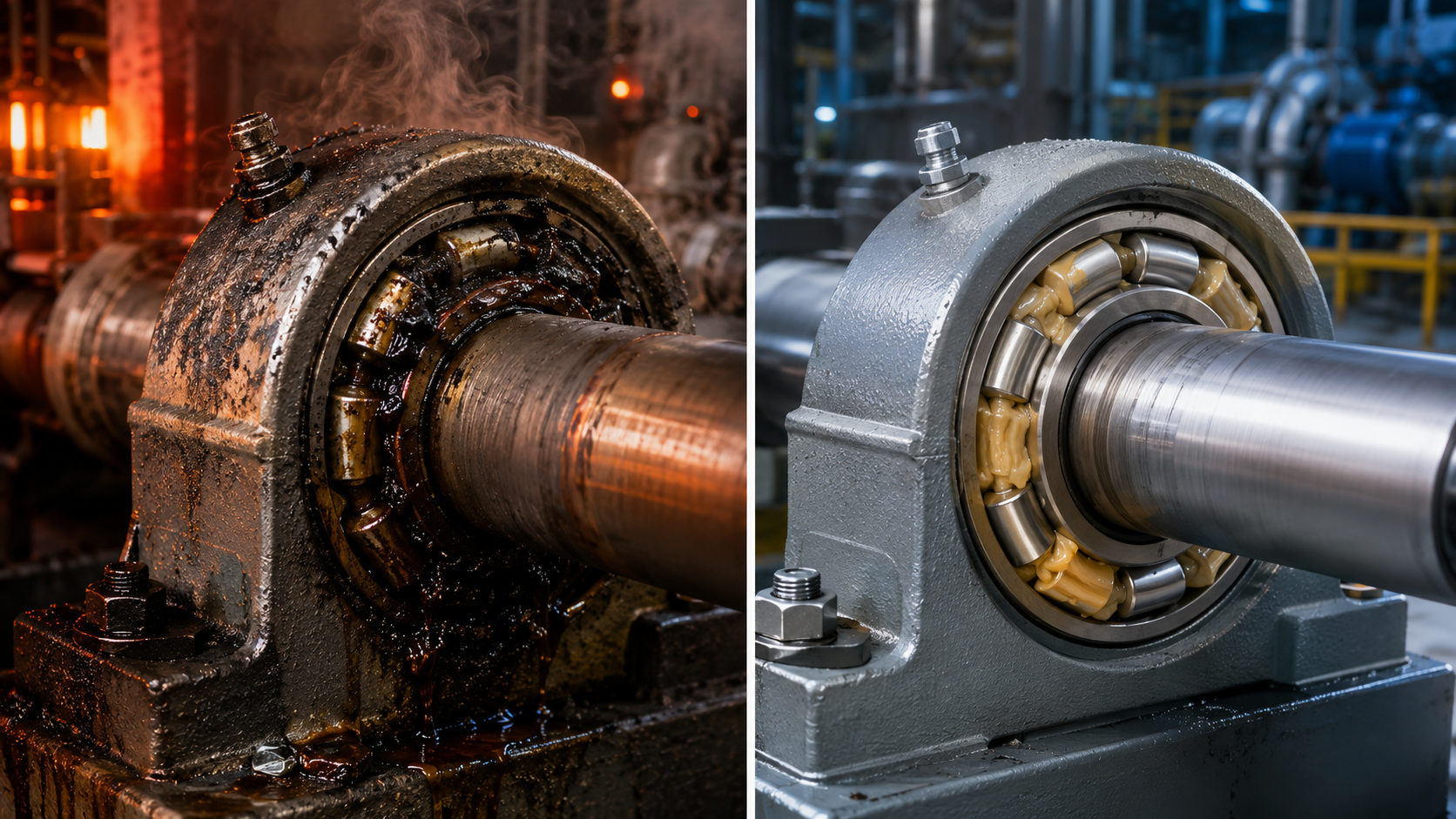
Bearing failures in high-temperature industrial environments follow a predictable pattern. The grease softens and migrates out of the bearing. Metal surfaces begin to contact each other without adequate lubrication. Wear accelerates. Temperature rises further. Eventually the bearing fails, during a shift, during a critical production run, at the worst possible moment.
What makes that pattern particularly frustrating is how avoidable it is. High-temperature bearing failures are almost never caused by bearing defects or unexpected operating conditions. They're caused by grease that wasn't formulated to handle the environment it was asked to perform in. The standard multipurpose lithium grease that works fine in moderate-temperature applications simply doesn't have the thermal stability to protect bearings running in high-heat industrial environments.
Understanding why standard grease fails at temperature, and what high-temp grease formulations do differently, is the foundation of a reliability program that protects equipment in the most demanding industrial environments.
Grease is a semi-solid lubricant consisting of a base oil, a thickener that holds the base oil in place, and an additive package that provides corrosion protection, oxidation resistance, and application-specific performance. In normal operating conditions, the thickener releases base oil gradually to lubricate the contact surfaces while retaining enough structure to keep the grease in place within the bearing.
Heat disrupts that system in two distinct ways.
Softening and bleed-out happens when the grease's dropping point, the temperature at which it loses its semi-solid structure, is approached or exceeded. Standard lithium grease has a dropping point in the range of 350°F to 380°F. That sounds adequate until you consider that bearing operating temperatures in high-heat industrial environments can approach or exceed those values, and that ambient temperature alone can bring a bearing's operating temperature significantly above what the surrounding environment registers. When grease softens beyond its design limits, it flows out of the bearing housing rather than staying in place to lubricate. The bearing is now running on whatever residual film remains, and that film depletes rapidly.
Oxidative degradation is a slower failure mode but equally damaging over time. Heat accelerates the oxidation of base oil, breaking down its lubricating properties and forming acidic byproducts and insoluble degradation products. Oxidized grease loses viscosity, forms deposits that can block lubricant flow paths, and eventually provides no meaningful lubrication. In high-temperature environments, the oxidation process that would take years at moderate temperatures can happen in months or weeks.
Both failure modes share a common feature: they're gradual, they're not immediately visible during routine inspection, and by the time symptoms such as elevated bearing temperatures, increased noise, or shortened regreasing intervals are detectable, significant wear has already occurred.
High-temperature grease formulations address the thermal limitations of standard grease through two primary engineering levers: thickener selection and base oil chemistry.
Thickener selection is the most important factor in high-temperature performance. The thickener determines the grease's dropping point, its structural stability limit, and its ability to retain base oil at elevated temperatures. Standard lithium greases use simple lithium soap thickeners with moderate dropping points. High-temp formulations use thickener chemistries with significantly higher dropping points and better thermal stability.
Base oil selection is the second lever. Synthetic base oils, polyalphaolefin (PAO), ester, or other synthetic chemistries, resist oxidation more effectively than mineral base stocks at elevated temperatures. High-temp greases built on synthetic base oils maintain their lubricating properties longer in hot environments than mineral-based formulations with the same thickener.
Additive packages in high-temp grease formulations are selected for compatibility with high-temperature operation, oxidation inhibitors effective at elevated temperatures, corrosion protection that holds up in hot environments, and in some cases EP additives where loading conditions demand them.
Three thickener chemistries dominate the high-temperature industrial grease market, each with distinct performance characteristics that make them more or less appropriate for specific applications.
Lithium complex grease builds on the familiar lithium soap thickener by adding a complexing agent that significantly raises the dropping point, typically to 500°F or above, compared to the 350–380°F range of simple lithium. Lithium complex grease handles moderate to high temperatures, accepts EP additives readily, and works well across a broad range of industrial bearing applications. It's the most widely used high-temp industrial grease for good reason: it balances performance, compatibility, and cost effectively. It is not, however, compatible with simple lithium grease. Mixing the two can cause unpredictable consistency changes.
Polyurea grease uses a non-metallic thickener chemistry that provides excellent oxidation resistance and high dropping points, typically above 500°F. Polyurea performs particularly well in electric motor bearings and applications where long regreasing intervals are desired. Its limitation is additive compatibility: polyurea thickeners don't accept EP additives well, making polyurea grease unsuitable for applications requiring extreme pressure protection. Polyurea is also incompatible with most other thickener types and should only be used in dedicated systems or after thorough purging.
Calcium sulfonate complex grease has emerged as a premium high-temp option with a combination of properties that few other thickener types can match: excellent water resistance, inherent EP performance without added sulfur-phosphorus chemistry (making it compatible with yellow metals), high dropping points above 500°F, and strong oxidation stability. Calcium sulfonate complex grease is particularly well-suited for demanding applications in wet or corrosive environments where EP protection and high temperature resistance are both required. Its cost is higher than lithium complex, but the application cases where it genuinely outperforms the alternatives justify the premium.
Two additional specifications matter in high-temperature grease selection: base oil viscosity and NLGI consistency grade.
Base oil viscosity affects film thickness at operating temperature. At high temperatures, base oil thins. A grease with a lower base oil viscosity thins more dramatically than one with a higher viscosity, potentially reaching the point where film thickness is inadequate for the bearing's load. High-temperature applications, particularly slow-speed or heavily loaded bearings, generally benefit from higher base oil viscosities that maintain adequate film thickness even as operating temperature rises.
NLGI grade describes the grease's consistency, how stiff it is. NLGI 2 is the most common grade for general industrial use, including most high-temp applications. Some high-temperature, high-speed applications benefit from a softer NLGI 1 grade that flows more readily into contact areas. Heavy, slow-speed applications may call for NLGI 3. The right consistency for a high-temp application depends on the bearing type, speed, and housing design. It's not a one-size-fits-all decision.
Selecting the right high-temp grease for a specific application comes down to four questions.
What is the actual bearing operating temperature? Not ambient temperature, operating temperature at the bearing itself, accounting for process heat, bearing heat generation, and heat from adjacent equipment. This is the number that determines whether a standard grease is adequate or a high-temp formulation is required.
What are the load and speed conditions? High loads push toward EP capability and higher base oil viscosity. High speeds push toward softer consistency grades and thickener types with good oil release rates. Slow-speed, high-load combinations are the most demanding scenario and may require calcium sulfonate complex or lithium complex with EP additives.
Are there compatibility costraints? Yellow metal components, existing grease types already in the system, and seal material compatibility all affect which thickener chemistry is appropriate. Mixing incompatible thickener types degrades both greases and can accelerate failure rather than prevent it.
What is the regreasing interval goal? Long intervals between regreasing, common in difficult-to-access bearing locations, demand the highest-performing formulations. Short intervals with frequent regreasing create more flexibility in product selection.
High-temperature bearing reliability is the product of three things working together: the right grease formulation for the application, the right quantity applied at the right frequency, and ongoing monitoring to detect problems before they become failures.
Delta360 supports high-temp grease programs across Gulf Coast industrial facilities with MLT/MLA-trained lubrication specialists who can evaluate applications, specify the right formulation from the Chevron grease portfolio, and implement precision greasing protocols, including ultrasonic greasing programs that take the guesswork out of regreasing quantity and frequency. Lubrication sampling and oil analysis through MRT Laboratories adds the monitoring layer that turns a grease selection decision into an ongoing reliability program.
For facilities where high-temperature bearing failures have been a recurring cost, that combination of product expertise, application knowledge, and monitoring capability is where the problem actually gets solved.
Dealing with recurring high-temp bearing failures? Talk to a Delta360 lubrication specialist about grease selection and reliability program development.

.png)








.png)
.png)