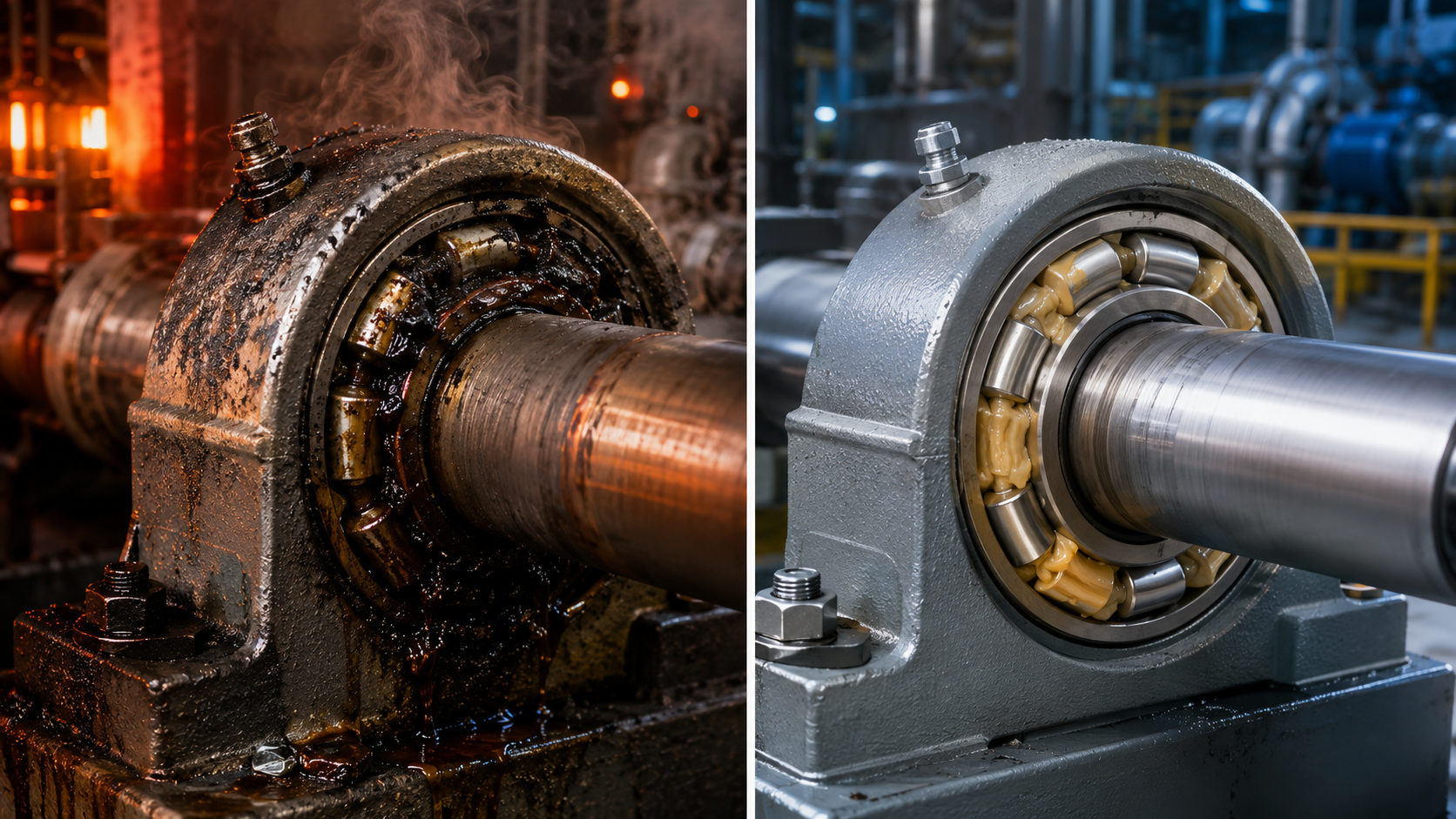
Tech Tip Tuesday: Heat Does Not Just Thin Grease. It Breaks It Down.





High-temperature bearing failures are often blamed on the bearing itself. The bearing gets noisy, vibration increases, temperatures rise, and eventually the component fails. At first glance, it can look like a mechanical defect or an unexpected operating issue.
In many cases, the real problem started with the grease.
Bearings operating in high-temperature environments need more than a general-purpose lubricant. They need a grease formulation that can handle the heat, stay in place, protect the rolling elements, and maintain a reliable lubricating film under load. When standard grease is used in the wrong environment, it begins to lose the properties that make it effective.
Grease is made up of base oil, thickener, and additives. Each part has a job. The base oil provides lubrication. The thickener helps hold the oil in place. The additives support performance under specific conditions such as load, oxidation, water, or corrosion.
When grease is exposed to temperatures beyond its design range, that balance begins to break down.
The grease may soften and bleed oil out too quickly. It may harden and stop releasing oil properly. It may oxidize, darken, or form deposits. In severe cases, it can separate, leak out of the bearing, or leave behind a dry, sticky residue that no longer protects the equipment.
Once the grease stops doing its job, the bearing is left vulnerable.
Standard grease may perform well in moderate conditions, but high-temperature environments create additional stress. Heat accelerates oxidation. It can reduce grease consistency. It can weaken the lubricant film. It can also cause the oil and thickener system to separate.
That means the grease may look like it is present, but it may no longer be protecting the bearing the way it should.
This is especially important in applications such as electric motors, ovens, conveyors, kilns, dryers, pumps, fans, and processing equipment where heat is part of the normal operating environment.
High-temperature grease failure usually leaves clues. Maintenance teams should pay close attention to changes in grease appearance, bearing temperature, and equipment behavior.
Common warning signs include:
These symptoms should not be ignored. Adding more grease may temporarily quiet the problem, but it does not solve the root cause if the grease formulation is wrong for the environment.
A properly selected high-temperature grease is designed to remain stable under heat. It should resist oxidation, maintain consistency, stay in place, and continue delivering lubrication to the contact surfaces.
The right formulation helps protect against:
It also helps reduce the tendency to over-grease. When a grease performs correctly, teams are less likely to keep adding more product to compensate for leakage, hardening, or poor performance.
Selecting the right grease is not just about temperature. Operating speed, load, environment, water exposure, compatibility, and relubrication practices all matter.
Before choosing a grease, maintenance teams should consider:
A grease that works well in one high-temperature application may not be right for another. The goal is to match the grease to the actual operating conditions, not just the product name or general category.
High-temperature bearing failures are rarely random. In many cases, they are the result of grease that was not formulated for the environment.
When grease breaks down, bearings lose the protective film they depend on. That leads to heat, wear, vibration, and premature failure.
Choosing the right high-temperature grease helps equipment run cleaner, cooler, and more reliably.
Delta360 helps industrial teams evaluate lubrication needs, identify problem applications, and select grease solutions built for real-world operating conditions.

.png)








.png)
.png)